— CARE2GRAPH FOR NURSING HOMES AND PSYCHIATRY
Wander prevention
Disoriented residents and patients often leave secure areas without anyone noticing. Care2Graph automatically triggers an alarm as soon as someone leaves a secure area – and automatically resets the alarm when the person returns of their own accord.
— BENEFITS FOR MAINTENANCE AND OPERATIONS
Less time spent searching, fewer interruptions, greater security
Advanced search
Filter options allow carers to see immediately which residents are in which room or are present in the dining room – this is also important during evacuations to ensure that everyone has left the ward.
Targeted alerting
The alarm is sent directly to the relevant staff on the ward in question – without placing an unnecessary burden on other wards.
Up to 50 per cent fewer false alarms
Alarms are suppressed when a carer is accompanying the person, and are automatically reset when the person returns unaided. This reduces the number of alarms by almost 50 per cent and avoids unnecessary interruptions to work.
Entry and exit control
Lock at the exit
Dementia tags activate a door lock as soon as a disoriented person approaches a door.
Additional function: room door
The dementia tag can also be used as a room key to unlock the door to one’s own room.
— THE CARRIER MEDIUM
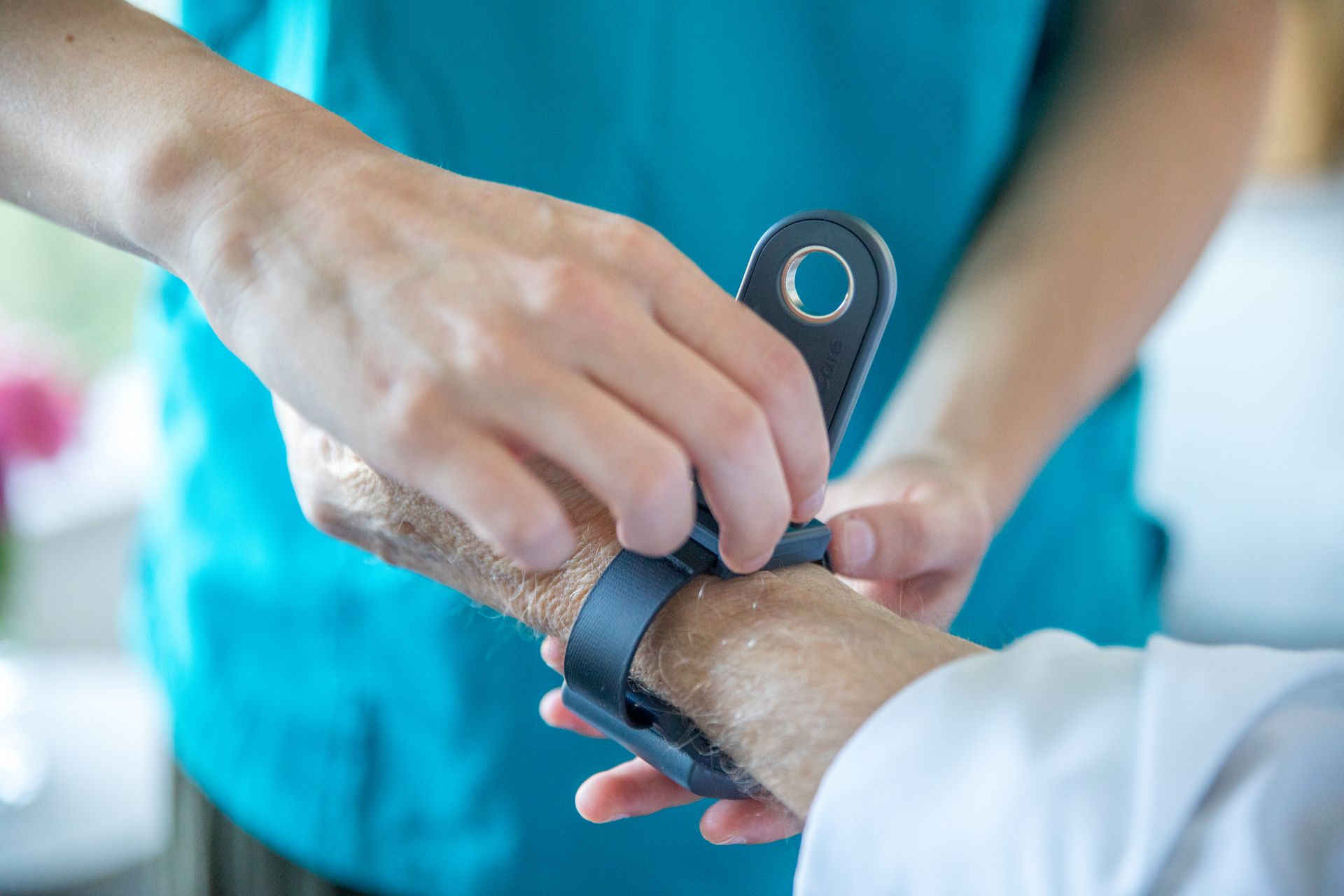
Dementia-Tag
Wearing styles
Available as a bracelet or pendant, and can be personalised.
Sturdy & waterproof
It can be worn whilst having a bath or shower without having to be taken off.
Battery monitoring
Alerts you in good time when the charge level is low; the battery is easy to replace by opening the lower part of the casing.
Safety lock
The lock can only be opened by staff – simply using the Martin.Care magnetic key.
— TECHNICAL OPERATION
Two methods of identification: Dementia-Tag or facial recognition
Care2Graph offers two alternative or combinable methods for implementing wander prevention – depending on the facility’s requirements.
Dementia Tag (RFID)
The person wears a tag with an active RFID chip. When they pass through a defined door zone, their position is detected and – depending on the configuration – an alarm is triggered or the door is locked. The alarm times can be programmed individually (e.g. at night only).
Facial recognition
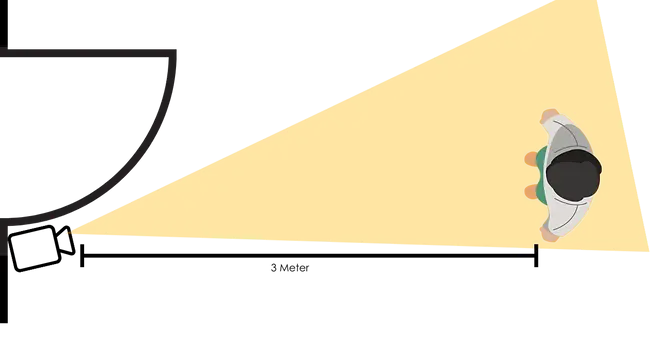
Alternative without a transmission medium: The alarm is triggered as soon as the face of a registered, disoriented person is detected at the door. Image processing takes place directly at the door – no image leaves the camera. Here too, the alarm is suppressed if the person is accompanied by staff.
Advanced search via NurseUI
The search interface makes it easier to search specifically for individual people in the building – filters can be used to quickly determine which room a resident is in or whether they are in the dining room.

— TECHNICAL INFORMATION (GERMANY)
Measures to prevent absconding and measures restricting liberty
Weglaufschutz ermöglicht Bewegungsfreiheit im gesicherten Bereich, statt auf mechanische Fixierung zurückzugreifen. Ob eine konkrete Weglaufschutzlösung rechtlich als freiheitsentziehende Maßnahme (FeM) gewertet wird, ist in Deutschland vom jeweiligen Bundesland und im Einzelfall vom zuständigen Amtsgericht abhängig – es gibt hierzu keine bundesweit einheitliche Regel. Einrichtungen sollten die Einordnung ihrer konkreten Umsetzung deshalb direkt mit dem zuständigen Amtsgericht klären.
Was FeM allgemein bedeuten und welche Alternativen diskutiert werden, erklären wir auf unserer Fachseite.
Frequently Asked Questions
What is wandering prevention in care?
Wander protection is a technical system that automatically detects people who are disoriented or suffering from dementia when they leave a secure area, and then alerts the care staff. Care2Graph uses dementia tags or facial recognition for this purpose, combined with zone logic at doors and exits.
What does a typical day for someone with dementia involve?
The person wears a tag with an active RFID chip on their wrist. When they pass through a designated door zone, their position is detected and, depending on the configuration, an alarm is triggered or the door is locked. The alarm times can be programmed individually, for example, to operate only at night.
Is an anti-escape measure a measure that restricts freedom?
There is no one-size-fits-all answer to this. In Germany, the legal classification depends on the relevant federal state and on the decision taken in each individual case by the competent local court. Organisations should clarify the specific details of their runaway prevention measures directly with the competent local court.
How many false alarms does the anti-wandering feature reduce?
Automatic alarm suppression when accompanied by care staff and automatic reset upon returning independently can reduce the number of alarms by up to 50 per cent.
Have we sparked your interest?
Arrange a no-obligation consultation.